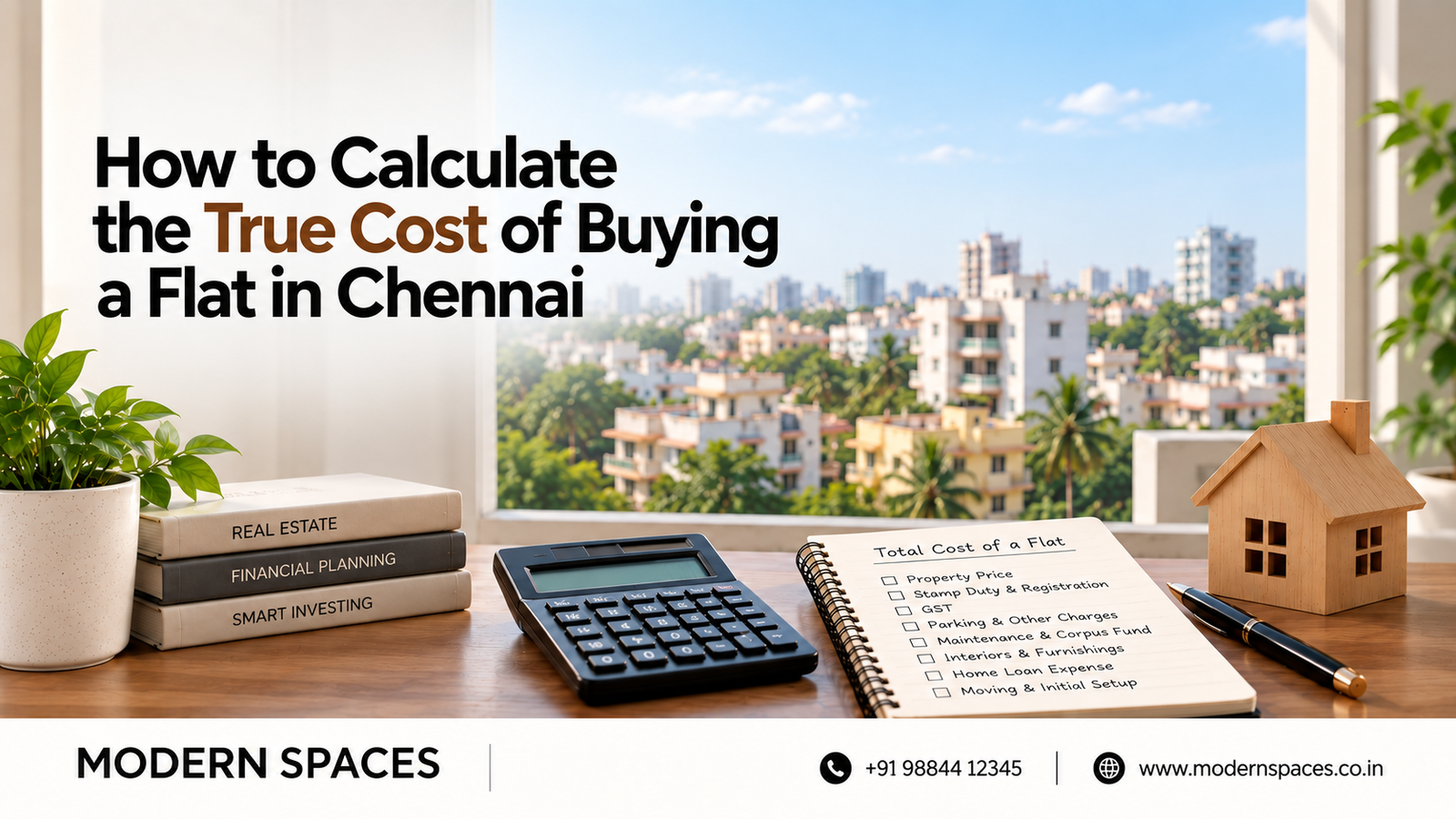
How to Calculate the True Cost of Buying a Flat in Chennai
Buying a flat in Chennai is a major financial decision. While most homebuyers begin by looking at the advertised property price, the actual amount required to purchase and settle into a home can be considerably higher.
Registration charges, applicable taxes, parking, maintenance deposits, interiors, home-loan expenses and other costs can all contribute to the final amount. Understanding these expenses before booking a property can help you create a realistic budget and avoid unexpected financial pressure later.
Start With the Basic Property Price
The first figure buyers usually consider is the apartment’s sale price. However, it is important to understand exactly what is included in that price.
Before paying a booking amount, request a detailed cost sheet from the builder or seller. Check whether the quoted amount includes parking, floor-rise charges, amenities and other project-related costs.
For resale properties, buyers should also check whether there are any outstanding maintenance charges, utility dues or other payments associated with the property.
Stamp Duty and Registration Charges
Property registration is another important expense that should be included in your overall budget.
In Chennai, buyers need to account for applicable stamp duty and registration charges when transferring ownership of a property. These expenses are separate from the property’s agreed sale price and can add a significant amount to the total purchase cost.
Since government charges and regulations can change, buyers should verify the current applicable rates and requirements with the Tamil Nadu Registration Department before completing the transaction.
GST on Under-Construction Properties
GST can be another consideration when purchasing an apartment from a developer.
Eligible under-construction residential properties can attract GST, with the applicable rate depending on the nature of the property and whether it qualifies under the affordable housing category. Completed properties where the entire consideration is received after the completion certificate or first occupation can have different GST treatment.
Therefore, buyers should ask the developer for a clear tax calculation and confirm the applicable GST treatment before making the purchase.
Parking and Other Additional Charges
Parking is another cost that buyers should clarify before booking a flat.
Depending on the project, there may also be charges associated with amenities, clubhouse facilities, electricity or water connections, documentation and other services.
Do not assume that everything mentioned in the project’s marketing material is included in the advertised property price. A written cost breakdown can help you understand exactly what you are paying for.
Maintenance and Corpus Fund
New apartment communities may require buyers to pay advance maintenance charges or contribute to a corpus or sinking fund.
These payments support the maintenance and upkeep of common areas and community facilities. Although they may appear relatively small compared with the property price, they can increase the amount you need to arrange at the time of possession.
Before purchasing, ask the builder or association about the maintenance structure, advance maintenance requirements and any applicable corpus contribution.
Interior and Furnishing Costs
Interior expenses are often overlooked when calculating the budget for a new home.
Once you receive possession, you may need to spend on wardrobes, modular kitchen work, lighting, fans, curtains, furniture, appliances and other household requirements.
For example, someone purchasing a ₹75 lakh apartment may still need a separate budget to make the home fully functional and comfortable.
The actual cost will depend on the size of the apartment, materials, design preferences and the level of customisation. Getting interior quotations before finalising your property budget can help you plan more accurately.
Home Loan-Related Expenses
If you are planning to finance your purchase through a home loan, consider the additional expenses associated with borrowing.
Depending on the lender and loan arrangement, there may be processing, documentation, valuation, insurance or other applicable charges.
More importantly, look beyond the monthly EMI. Consider the total amount payable throughout the loan tenure and make sure the repayment fits comfortably within your overall financial plan.
Moving and Initial Setup Costs
There are also several smaller expenses that can arise after purchasing a property.
Moving costs, basic household appliances, utility connections, furnishings and other initial setup requirements can add to your first-year expenses.
Individually, these costs may not seem significant, but together they can make a noticeable difference to the amount you spend after purchasing your home.
A Simple Example: A ₹75 Lakh Apartment
Suppose you are considering an apartment priced at ₹75 lakh.
It would be a mistake to assume that ₹75 lakh is necessarily the complete amount you need.
Depending on the property and transaction, you may also have to account for registration-related charges, applicable GST, parking or project charges, maintenance deposits, interiors, appliances, moving expenses and home-loan-related costs.
This is why the better question is not simply:
“Can I afford a ₹75 lakh flat?”
Instead, ask:
“What will be the total cost of purchasing and making this flat ready to live in?”
This approach provides a much more realistic picture of affordability.
Create a Complete Property Budget Before Booking
Before paying the booking amount, prepare a complete budget covering three major areas: the property cost, transaction and statutory expenses, and post-purchase expenses.
Ask the builder or seller for a detailed cost sheet and clarify every additional charge. At the same time, keep a contingency amount for unexpected expenses.
This approach can help prevent a situation where the apartment appears affordable initially but becomes difficult to manage after all additional expenses are added.
Conclusion
Buying a flat in Chennai is a long-term financial commitment, and the advertised property price is only the starting point. Registration charges, applicable taxes, parking, maintenance, interiors, financing costs and other expenses can all influence the final amount you spend.
Before making a booking, take the time to calculate the complete cost of buying and setting up your home, rather than looking only at the sale price. Ask for a detailed cost sheet, verify applicable government charges and keep some financial room for unexpected expenses.
A clear understanding of the total cost can help you plan your finances more effectively and choose a property that fits comfortably within your budget.
For more property insights, home-buying guidance and real estate information in Chennai, visit Modern Spaces.